

The Problem
Most foster care resources online are written by agencies with a recruitment goal, or by government websites that haven't been updated since 2019. The information technically exists. It's just spread across six different .gov PDFs and written for bureaucrats, not people.
When my husband and I started the licensing process in Pennsylvania, we spent more time hunting for basic answers than we did actually preparing. What does the home study look like? Which agencies in our county work with same-sex couples? What's the timeline, realistically? Nobody had written a plain-language version of any of it.
Fostura is the attempt to fix that. Free, no paywalls, no recruitment pitch. State-specific licensing guides for all 50 states, a searchable agency directory, and an article library covering the parts of the process that nobody explains upfront. Built by foster parents who went through it, not agencies with something to sell you.
Getting the data
State licensing directories are a mess. Some states publish a clean, downloadable list. Some have a card grid on a government subdomain last updated in 2021. Some publish nothing publicly at all.
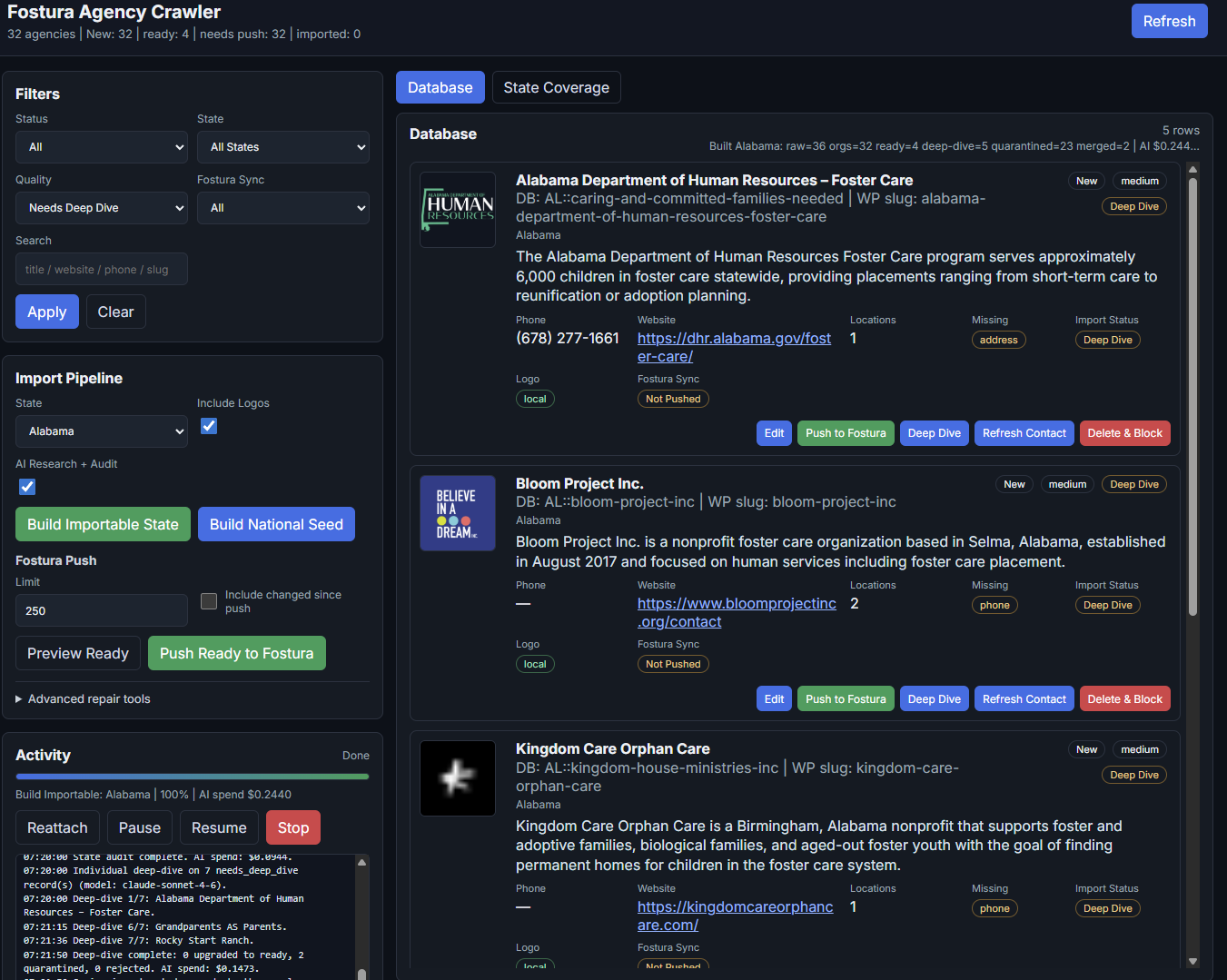
I built a Python crawler to normalize that. For states with a usable directory, it parses the source directly, whatever format the state happened to choose: HTML, tables, CSVs, spreadsheets, PDFs. For states where the official source is JavaScript-rendered, login-gated, or just broken, it falls back to secondary sources, including the IRS Exempt Organizations BMF. Nonprofits in child welfare cluster under specific NTEE codes, and the BMF catches smaller organizations and newer licensees that never show up in official directories.
For the states that are genuinely inaccessible, there's a third-tier fallback that combines targeted search queries with Claude doing structured extraction from unstructured results. It's not the first approach, but it works when nothing else does.
The goal throughout was coverage, not elegance. Every state needed a result.
The review pipeline
Raw crawl output is noisy. A broad net catches all of it: support organizations, advocacy groups, foster closets, residential facilities. Most of it doesn't belong on the site.
Every record runs through a tiered AI review pipeline before it gets anywhere near an import. Haiku handles the first cut in batches, biased toward keeping records rather than dropping them. At that volume and cost, false positives are cheap, and missing a real agency isn't. Sonnet runs the state-level audit, sorting each record into clean, needs-review, or quarantine. Anything flagged for a closer look gets a dedicated deep-dive: the crawler pulls additional evidence from the agency's own site before a final determination gets made. A last Haiku pass rewrites the descriptions using copy from each agency's actual homepage, so what ends up on Fostura is accurate and consistent rather than whatever fragment the crawl happened to surface.
By the end of the pipeline, nothing is unresolved. A record is either in or it's gone.
Running a single state costs roughly one to two dollars in API calls. All 50 lands somewhere between $50 and $100 total, which felt like the right number for something that would have taken weeks to do manually.
The pipeline gets you most of the way there. The rest is hours of manual review -- going state by state, spot-checking edge cases, making judgment calls the model can't. I'm not done with that process, but the site is at a point where it's useful. MVP first, polish ongoing.
Building the site
The site runs on WordPress as a custom FSE block theme, no page builder. Fields are registered manually rather than through ACF, which keeps the dependency footprint light and easier to maintain long-term.
Agencies are a custom post type filtered by state and county through FacetWP. Placement types and attributes like "LGBTQ+ Affirming" and "Bilingual Services" are visible on agency cards already; the facets for those are next. State guides are a hierarchical post type: one hub per state, child guides for sub-topics like home studies, licensing timelines, financial support, and training requirements. All 50 hubs generate on theme activation.
The URL structure mirrors the taxonomy hierarchy. A county-filtered view at /states/pennsylvania/allegheny/ works without any custom query logic per combination. Adding a new state or county doesn't require touching anything beyond the taxonomy itself.
There are four custom Gutenberg blocks. The one that took the most time is the state map: an interactive SVG of the full US where clicking a state routes to either its guide or its filtered agency listing. One PHP-rendered block, no JavaScript framework.
The design
The design took a few passes to get right. Early versions were clean but cold, and cold was the thing to avoid. Most of what exists in the foster care information space looks like a government form. The families using this site are in the middle of one of the more emotionally loaded processes there is. The design had to feel like it understood that.
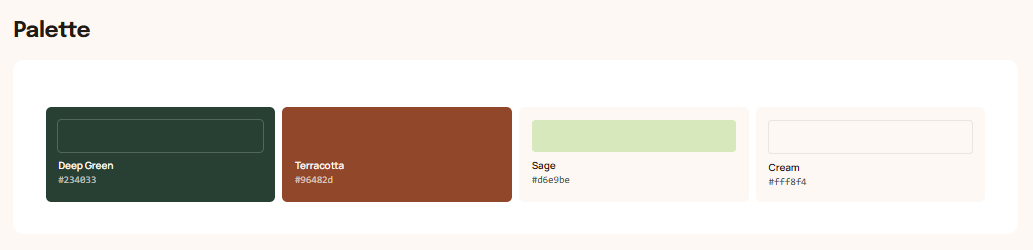
I kept landing on earthy and warm. We're a foster family ourselves. My husband and I have been through the process, and we're still in it. That informed the palette more than any mood board did. Deep green as the primary, terracotta as the secondary, off-white surfaces layered underneath for depth. Epilogue for display type, Manrope for body. Sections divide by color shift rather than drawn borders. No 1px lines anywhere.
It went through several rounds. The first version felt like it was performing warmth without quite earning it. The second overcorrected and started looking like a startup template. The version that landed leaned harder into the earth tones and let the typography carry more of the weight. That was the one that finally felt right. Like it was actually about families, not just adjacent to them.
What's next for Fostura
Fostura just launched, and there's still a lot of road ahead. The agency directory needs more manual review passes. The state guides are live but the sub-topic content is still rolling out. The filter facets for placement type and agency attributes aren't wired yet. The to-do list is long, and I'm working through it.
But the foundation is there, and that matters to me more than I expected it to.
We started the foster care licensing process years ago with no real roadmap. We visited a lot of government websites. We read a lot of outdated PDFs. We asked a lot of questions that took weeks to get answered. We had each other and enough patience to get through it. A lot of prospective parents don't have that same runway.
We've adopted once through foster care, and we're going to again soon. We plan to keep fostering as long as we've got space in the house. It's how we built our family, and it's a process that's hard in ways that don't have to be as hard as they are. Fostura is the resource I wish had existed when we started. If it helps even a handful of families get through licensing with less friction and more confidence, that's enough.
If you're in the process, or thinking about starting it, I'd love to hear from you.
Fostura | Find Foster Agencies, State Guides, and Practical Support
Search foster agencies, browse state guides, and access practical foster care articles and resources built for families getting started.